In the annals of space weather history lies an extraordinary event that forever changed our understanding of the potential impacts of solar activity on Earth. The Carrington Event, named after the British astronomer Richard Carrington, was a powerful solar storm that occurred in 1859. Aside from showcasing mesmerizing auroras, this event had far-reaching consequences, disrupting telegraph systems and challenging our preparedness for similar events in the modern era. In this article, we will delve into the details of the Carrington Event, explore its implications, and consider the potential impact of a similar event in the present day.
The Solar Storm of 1859:
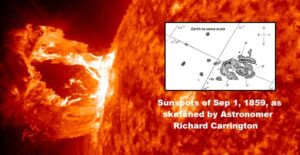
In the mid-19th century, the Sun unleashed an intense geomagnetic storm that created unprecedented disturbances on Earth. On September 1, 1859, Richard Carrington observed an incredibly bright white light flare erupting from the Sun’s surface, signaling the onset of a colossal solar storm. The resulting coronal mass ejection (CME) expelled billions of tons of highly energized particles towards Earth at an alarming rate.
Impacts on Earth:
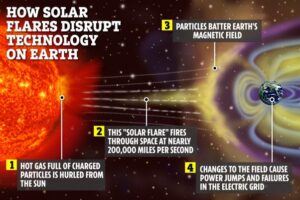
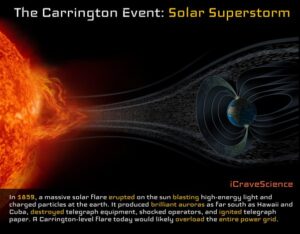
The Carrington Event triggered a chain of events that reached Earth within 17 hours. The intense barrage of solar particles bombarded our planet’s magnetic field, causing widespread geomagnetic disruptions. The most discernible impact was the extensive disruption of telegraph systems worldwide. Telegraph operators reported receiving strong electric shocks, telegraph poles catching fire, and even successful communication occurring after disconnecting the power supply due to induced currents.
Stunning Auroras:
One of the most captivating outcomes of the Carrington Event was the awe-inspiring display of auroras. Brilliant, shimmering lights danced across skies usually devoid of such ethereal beauty. The charged particles from the Sun interacted with Earth’s atmosphere, causing the release of vibrant hues of green, red, and purple. Witnesses marveled at this rare spectacle, even in locations close to the equator where auroras are typically not seen.
Potential Impact of a Similar Event Today:
The Carrington Event serves as a stark reminder of the potential vulnerabilities of our modern technological infrastructure. Today, our dependence on satellites, power grids, and advanced communication systems makes us more susceptible to the consequences of a massive solar storm. While Carrington’s storm had minimal impact due to the limited technology at the time, a repeat event on such scale could wreak havoc on our interconnected digital world.
Power Grid Disruptions: A severe solar storm could overload power grids, leading to widespread blackouts. The intense electromagnetic pulses induced by a solar event could irreparably damage transformers and electrical equipment, necessitating significant financial investments and prolonged downtime to restore services.
Satellite Communications: Satellites play a crucial role in modern communication, weather monitoring, and navigation systems. During a severe solar storm, heightened radiation levels and increased particle activity can disrupt or even destroy satellite electronics, impeding communication capabilities, GPS accuracy, and weather forecasting.
Financial Implications: The economic losses resulting from a modern Carrington-level event could be astronomical. Disrupted power grids, communication systems, and satellite failures would impact industries such as banking, transportation, commerce, and emergency services. The repercussions are not limited to individual nations but extend globally, causing an unprecedented financial crisis.
Preparedness and Mitigation:
Understanding the potential impact of a modern Carrington Event requires proactive measures to ensure our preparedness. Governments, space agencies, and power utility companies should invest in robust infrastructure designed to withstand and recover from severe solar storms. Improved forecasting systems, rapid communication protocols, and effective backup systems can minimize the risks associated with such disruptions.
Conclusion:
The Carrington Event of 1859 was a remarkable solar storm that exemplified the immense power our parent star possesses. Its impact on telegraph systems and the enchanting auroras it produced remind us of the importance of being adequately equipped to deal with similar threats in the modern era. Continued research, enhanced infrastructure, and international cooperation will play critical roles in our journey to protect our society from the potential consequences of such celestial phenomena.